Article Highlights
- State and local governments face a widening skills gap driven by rising cyber threats, an aging workforce, and rapid technological change.
- 76% of talent development professionals report a current government skills gap, with 738,000 job vacancies as of December 2023 and a wave of retirements on the horizon.
- Cyberattacks are accelerating — Kansas saw a 48% increase in attacks on state and local entities, and 34% of state and local governments were hit by ransomware in the past year, with mean recovery costs topping $2.83 million.
- Strategic, role-based upskilling in cybersecurity, AI literacy, and leadership — paired with pre-negotiated contract vehicles like GSA, CMAS, DIR, and Costars — helps SLED agencies close the gap faster and more affordably.

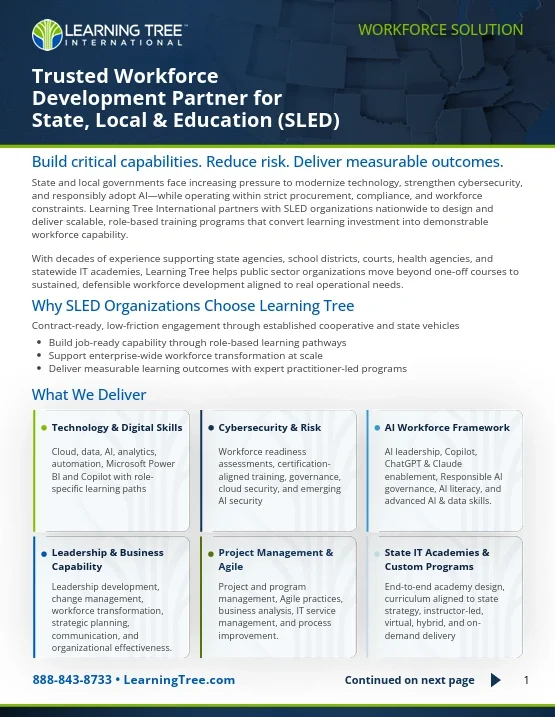
New brochure: See how Learning Tree supports state and local government workforce development. Download the SLED Training Solutions brochure (PDF).
The numbers tell a stark story. According to the Association for Talent Development (ATD), 76% of talent development professionals report a current skills gap in the government workforce, and 78% expect that gap to persist. As of December 2023, there were 738,000 job vacancies across all levels of government. A wave of retirements is accelerating the problem further, with one Massachusetts survey finding that a third of municipal Treasurer/Collectors and nearly a quarter of Accountants and Auditors planned to retire within five years.
The consequences are not abstract. Between 2023 and 2024, Kansas reported a 48% increase in cyberattacks targeting state and local government entities. A May 2024 attack on the City of Wichita forced a temporary shift to cash-only payments. A September 2024 breach in Franklin County exposed the sensitive personal records of 30,000 residents. These incidents are not isolated. According to the Sophos "State of Ransomware 2024" report, 34% of state and local government organizations were hit by ransomware attacks in the past year, with the mean recovery cost more than doubling to $2.83 million.
Why the government skills gap is getting harder to close
The skills gap in state and local government is not the product of a single failure. Several forces converge to make this a deeply structural problem, and understanding them is the first step toward solving it.
Digital transformation is the primary driver. The rapid rise of artificial intelligence, cloud computing, and data analytics is reshaping how government work gets done. Two-thirds of government agencies acknowledge they are culturally and operationally unprepared for AI transformation, according to the International City/County Management Association (ICMA). Yet citizens increasingly expect the same seamless, digital-first experiences from government that they receive from private sector services. That gap between expectation and capacity is widening every year.
Workforce demographics compound the pressure. Public sector HR managers anticipate the largest wave of retirements in the coming years. Each departure takes decades of institutional knowledge with it. Replacing that experience through traditional recruitment is difficult when agencies are competing against the private sector for the same technical talent, often with less competitive compensation.
Geography creates an additional layer of inequity. Rural governments face systemic disadvantages in accessing training infrastructure and reliable broadband, limiting their ability to upskill staff and retain talent. The result is an uneven distribution of capability across the country, with smaller and more rural agencies carrying a disproportionate share of vulnerability.
What a modern government workforce actually needs
Addressing the gap requires clarity about which skills matter most. The ATD identifies critical thinking and project management among the top three skills currently lacking in the government workforce. Beyond those, two categories of capability stand out.
On the technical side, cybersecurity remains the most urgent priority. A recent audit in Kansas found that nearly half of 15 audited state and local entities did not substantially comply with applicable IT security standards, with specific weaknesses in system patching, incident response planning, and security awareness training. AI literacy is quickly becoming a core competency as well, with public servants needing practical knowledge of what AI tools can do, where they fall short, and the governance risks involved. Cloud computing and data analytics round out the technical skill set that modern agencies require.
On the leadership and management side, agencies need adaptive leadership, strong communication skills, and the capacity for change management. These are not soft extras. They are the difference between a workforce that can execute a digital transformation and one that stalls in the planning phase.
How strategic upskilling works in practice
General workforce training rarely solves a government problem. Agencies need training that is role-specific, compliance-aligned, and designed to produce measurable outcomes that can be demonstrated to stakeholders and taxpayers. Federal mandates such as DoDD 8140, ITIL, and SAFe set clear frameworks, and training must be built around them, not retrofitted afterward.
Subscription-based learning models have gained traction in the public sector precisely because they reduce per-user costs while providing unlimited access across a distributed workforce. This matters for state and local agencies operating under tight, predefined budgets. Flexible delivery, including virtual, hybrid, and on-demand formats, allows training to reach staff across geographically dispersed offices, connecting them to the benefits of live, instructor-led training, without requiring significant travel expenditure.
Procurement is also a strategic lever. State and local agencies can access pre-negotiated government contract vehicles to engage established training vendors quickly, bypassing lengthy RFP processes. Learning Tree International, for example, holds a GSA Schedule contract (GS-35F-369CA) active through June 2035, a California CMAS contract (3-22-06-1063), a Texas DIR contract (DIR-CPO-5045), and a Pennsylvania Costars contract (4400004480). These vehicles cover training in IT, cybersecurity, AI, and professional development, and they allow state and local agencies to begin procurement without starting from scratch.
The results from applied programs are measurable. A Learning Tree training program delivered to nearly 1,000 participants across California's Judicial Council court system achieved a 97% positive attendee rating and a 132% increase in participant knowledge. The State of Tennessee's IT Academy, a multi-year program supporting over 1,500 state IT staff, has delivered consistent improvements in confidence, application, and productivity. Texas Cyber Command partnered with Learning Tree on a statewide InfoSec Academy to deliver role-based, certification-aligned cybersecurity training at scale.
To put these strategies into practice, pair them with structured training across the disciplines a resilient SLED workforce needs to master:
Download the SLED Training Solutions Brochure
Build a workforce your state can rely on
Upskilling state and local government workforces is an investment in operational excellence and public safety. Every dollar spent on targeted, role-based training in cybersecurity, AI adoption, leadership, and project management directly reduces the risk of service disruption, data breach, and compliance failure. When agencies pair that training with the right procurement vehicles and a culture of continuous learning, they move from reactive to resilient.
Learning Tree International specializes in government-ready workforce development, offering scalable solutions aligned to compliance requirements, procurement vehicles, and the real operational needs of SLED organizations.
Read the SLED brochure to see how Learning Tree supports state and local government workforce development, then contact our team to discuss a solution for your state or local government.
Frequently Asked Questions (FAQs)
What is causing the skills gap in state and local government?
The skills gap results from three converging pressures: rapid digital transformation that outpaces current workforce capabilities, an aging workforce generating an accelerating wave of retirements, and rising citizen expectations for digital-first services. According to the ATD, 76% of talent development professionals currently report a skills gap in the government sector, and 78% expect it to continue.
Which skills are most urgently needed in state and local government workforces?
Cybersecurity is the most critical technical skill, given the increasing frequency and cost of ransomware attacks. AI literacy, data analytics, and cloud computing are also high priorities. On the leadership side, critical thinking, project management, and adaptive leadership are among the most commonly identified gaps, according to ATD research.
How should state and local agencies procure workforce training efficiently?
Agencies can use pre-negotiated government contract vehicles to reduce procurement timelines and complexity. Tools such as the GSA Multiple Award Schedule, state-level contracts like California's CMAS, and cooperative purchasing agreements allow agencies to engage qualified training vendors quickly and within compliance requirements.
What makes government upskilling different from private sector training?
Government training must align with federal mandates and frameworks such as NIST CSF 2.0, DoDD 8140, and SAFe. It also needs to accommodate distributed workforces, varying levels of broadband access, and strict budget accountability. Measurable outcomes matter more in the public sector, where program results are subject to taxpayer and legislative scrutiny.
How does Learning Tree International support SLED workforce development?
Learning Tree International delivers role-based training programs in cybersecurity, AI, leadership, data analytics, and project management. The company holds multiple government contract vehicles including the GSA Schedule, California CMAS, Texas DIR, and Pennsylvania Costars contracts, making engagement straightforward for state and local agencies. Programs range from individual certifications to multi-year statewide IT academies.
What return can agencies expect from investing in workforce training?
Research shows that teams in which every member receives 40 hours of relevant training are three times more likely to meet project objectives. Beyond productivity, training improves talent retention, reduces the cost of turnover, and builds a more adaptable workforce capable of responding to new threats and mandates.