Article Highlights
- Government agencies investing in workforce readiness programs see faster AI adoption, stronger governance, and measurable productivity gains.
- Only 34% of public-administration managers believe their workforce has the skills needed for AI integration, workforce readiness, not tool access, is the real bottleneck.
- A Learning Tree International case study showed a 20% productivity increase in one public-sector organization after targeted AI training.
- Teams using Microsoft Copilot in their workflow reported a 27% productivity boost.

Most AI initiatives do not fail, they stall quietly. Not because of the technology, but because adoption never takes hold.
Organizations struggle to translate AI investments into three outcomes: new workforce behaviors, secure adoption practices, and measurable business results.
For government agencies, where governance and compliance requirements are especially high, workforce readiness becomes the difference between experimentation and impact. Workforce readiness means giving employees the skills, confidence, governance guidance, and practical experience needed to use AI responsibly in their daily work.
Many public-sector organizations roll out AI platforms only to see adoption stall due to skill gaps, lack of confidence, or inadequate governance practices.
The bottleneck isn't the technology, it's the people using it. For government agencies with strict security and compliance standards, this can result in serious setbacks.
Why AI adoption stalls in government
The pressure to adopt AI is growing as agencies look to improve efficiency and reduce costs. However, only 34% of public-administration managers believe their workforce has the skills needed for AI integration, according to Learning Tree's research. This skills gap doesn't resolve itself and is often due to three key challenges:
1. Skills gaps across roles
AI implementation affects more than IT teams. Business professionals, project managers, and operations staff need training specific to their roles. Without it, employees may avoid AI altogether or use it in ways that increase security risks.
2. Compliance and data handling issues
Government environments require specialized knowledge around data security, access controls, and responsible AI use. Generic training doesn't meet these needs, leaving employees unprepared to handle sensitive information securely.
3. One-size-fits-all training fails
Training that treats every role the same doesn't work. A cybersecurity analyst and a program manager need different skills, and generic content leads to low engagement and poor retention.
Why workforce readiness matters more than tool deployment
The organization's challenge was not choosing an AI platform. Leadership had already identified the opportunity. The challenge was creating a structured path from awareness to practical, secure application across the workforce.
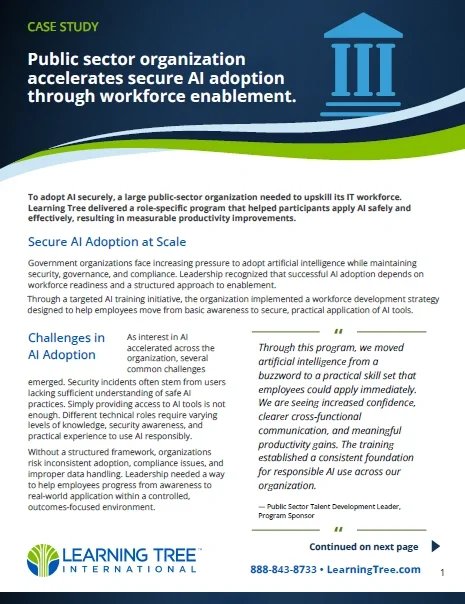
New case study: Download the full case study to see exactly how Learning Tree structured this AI program and what it delivered for the public sector organization.
The difference between a struggling AI rollout and a successful one often comes down to a structured approach. A government AI readiness program should create the conditions for successful adoption by helping employees develop practical AI skills, apply them in their daily work, and demonstrate measurable outcomes.
Learning Tree International helped a public-sector organization design a targeted AI training program based on these principles. The program included:
- Instructor-led training with hands-on labs.
- Secure environments for practice.
- Structured evaluations to measure real behavior change.
The program's goals included establishing secure AI usage standards, providing role-specific enablement experiences, promoting responsible data handling, and building confidence in AI tools. These efforts directly addressed the common barriers to AI adoption.
The organization's challenge was not simply helping employees understand AI. It was helping them apply AI responsibly in the context of their existing roles, workflows, and governance requirements. The goal was to create sustainable adoption, not temporary enthusiasm generated by a technology rollout.
"We moved artificial intelligence from a buzzword to a practical skill set that employees could apply immediately. We're seeing greater confidence, clearer communication, and meaningful productivity gains."
— Program Sponsor
What successful AI adoption has in common
Agencies that succeed with AI adoption follow a deliberate process:
Align leaders around outcomes
The organization recognized that successful AI adoption depended on workforce readiness, governance, and practical application, not simply access to AI tools. Leadership established priorities around secure AI usage, role-based enablement, and measurable outcomes before scaling adoption efforts.
Build learning around real work
Rather than relying on generic awareness training, the program emphasized role-specific learning, practical application, and hands-on experiences that participants could immediately apply in their daily work.
Reinforce behaviors through application
The program used hands-on labs, secure learning environments, and structured practice opportunities to help participants move from awareness to confident, responsible AI usage. The goal was not simply knowledge transfer, but lasting behavior change.
Measure what changed
The organization measured behavior change and business impact through structured evaluation. Productivity gains, increased confidence, and observable workplace improvements provided evidence that the program was delivering value and justified broader expansion.
Measuring impact and sustaining progress
Training success must be measurable to justify continued investment. Effective programs track outcomes like productivity increases, tool usage rates, and employee confidence. For example, Learning Tree's program used the Kirkpatrick model to measure behavior changes and business impact.
The results spoke for themselves. Participants reported a 20% productivity gain, which rose to 27% among those using Microsoft Copilot. These outcomes provided the evidence needed to expand the program statewide.
To sustain progress, agencies should:
- Collect post-training feedback.
- Update content as AI tools evolve.
- Foster a culture where AI competency is seen as an ongoing priority.
From pilot to statewide adoption
The case study's success led to a statewide rollout in October 2025. This illustrates that the path to large-scale AI adoption starts with a well-designed pilot. By focusing on a high-priority use case, measuring outcomes, and building workforce capability around real-world use cases, agencies can create a scalable model for broader implementation.
Build AI readiness that delivers results
The lesson from this case study is not that AI training works. It is that AI adoption requires more than training. The organizations most likely to achieve measurable value are those that align stakeholders around clear outcomes, build capability through real-world application, reinforce new behaviors, and measure impact from the beginning. Those principles are what transform AI from an experiment into a scalable workforce capability.
Ready to see what this approach looks like for your agency? Explore Learning Tree's AI workforce solutions and connect with experts who help public-sector organizations achieve measurable AI success
Frequently Asked Questions (FAQs)
What does government workforce readiness for AI actually require?
Government workforce readiness for AI requires more than access to tools. Agencies need role-specific training that addresses practical workflows, secure environments for hands-on practice, governance frameworks for responsible data handling, and measurement systems that track behavior change after training ends. Without these elements, AI adoption tends to stall at the awareness stage.
Why do workforce readiness programs outperform generic AI awareness initiatives?
Generic awareness training delivers the same content to every employee regardless of their responsibilities. A security professional and a program manager use AI differently, face different compliance risks, and need different skills. Role-based training aligns content to real workflows, which drives faster skill acquisition, higher confidence, and more consistent adoption across the workforce.
How should government agencies measure the success of an AI training program?
Effective measurement goes beyond satisfaction scores. Agencies should track behavior change after training, productivity gains, AI tool usage rates before and after the program, and employee confidence in applying AI responsibly. Using a structured evaluation framework, such as the Kirkpatrick model, helps translate training outcomes into executive-ready evidence of business impact.
What security considerations are specific to government AI training?
Government employees working with sensitive or classified data need explicit instruction in secure AI usage practices, data classification requirements, and acceptable use standards before accessing AI tools. Training programs should include secure lab environments where participants can practice without risk to live systems or compliance standing.
How long does it take to see measurable results from a government AI enablement program?
Results vary based on program scope and agency size, but targeted enablement programs can produce measurable outcomes within weeks. In Learning Tree International's public-sector case study, participants began applying AI in planning and decision-making shortly after program completion, with a reported 20% overall productivity increase documented in post-training evaluations.
Can a government AI training program scale from a pilot to an agency-wide rollout?
Yes. A well-designed pilot that produces clear, documented outcomes provides the evidence needed to justify broader deployment. The most effective approach is to start with a focused cohort, measure rigorously, and use those results to build the case for statewide or agency-wide expansion.